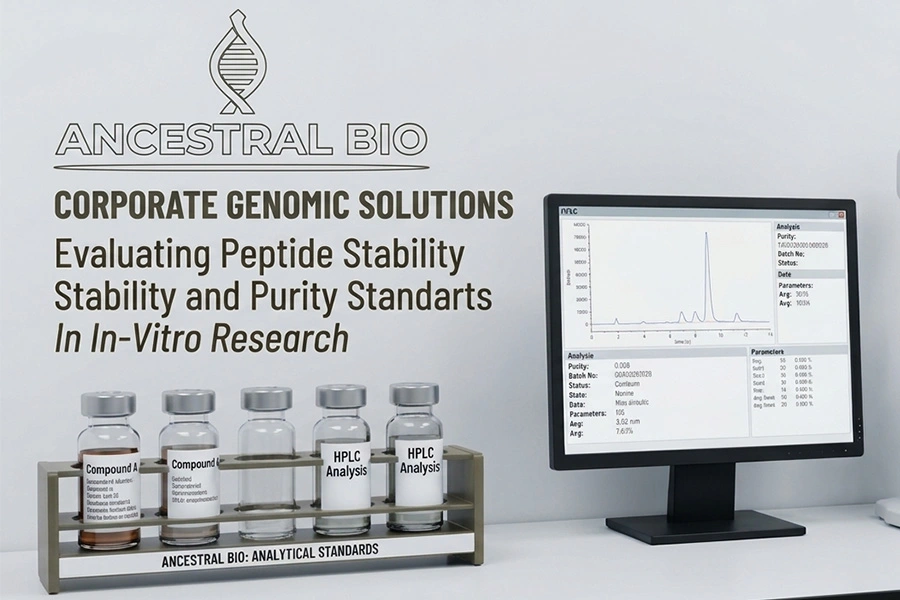
Evaluating Peptide Stability and Purity Standards in In-Vitro Research
In cellular biology, metabolic research, and analytical assay development, the structural integrity of research compounds dictates experimental validity. Minor variations in peptide purity, storage conditions, or reconstitution protocols can introduce confounding variables into in-vitro models. Maintaining rigorous analytical standards—backed by verifiable third-party testing—is essential for reproducible data.
1. The Critical Role of Third-Party Verification (COAs)
When procuring research-grade peptides, relying on manufacturer specifications alone is insufficient. Independent verification through High-Performance Liquid Chromatography (HPLC) and Mass Spectrometry (MS) ensures that each batch meets exact purity thresholds.
- HPLC Analysis: Identifies potential impurities, truncated sequences, or degradation products within the batch.
- Mass Spectrometry: Confirms molecular weight and primary sequence identity.
- Batch Transparency: Providing accessible Certificates of Analysis (COAs) allows research teams to verify exact net peptide content versus total compound weight prior to assay execution.
2. Lyophilization and Thermal Stability Management
Most synthetic peptides are supplied as lyophilized (freeze-dried) powders to maximize shelf life and prevent structural degradation. However, environmental factors during storage heavily influence stability:
- Temperature Control: While most lyophilized peptides remain stable at room temperature for short durations, long-term storage requires freezing at -20°C to -80°C in a desiccated environment.
- Moisture Prevention: Hygroscopic peptides can absorb atmospheric moisture upon thermal cycling. Vials should always be allowed to equilibrate to room temperature before opening to prevent condensation buildup.
3. Best Practices for Reconstitution and Solvent Selection
Transitioning a lyophilized compound into an active in-vitro solution requires precise solvent selection based on the peptide’s hydrophobic/hydrophilic profile:
- Primary Solvents: Sterile, bacteriostatic water or PBS (phosphate-buffered saline) is standard for hydrophilic peptides.
- Cosolvents: For hydrophobic sequences, small amounts of dilute acetic acid or DMSO may be necessary to facilitate initial dissolution without disrupting cellular viability assays.
- Filtration: Passing reconstituted solutions through a 0.22 μm syringe filter ensures sterility for cell culture applications.
4. Minimizing Shear Stress and Freeze-Thaw Degradation
Repeated freeze-thaw cycles can cause physical shear and peptide aggregation, significantly reducing bioactivity.
Laboratory Protocol Tip: Aliquot reconstituted stock solutions into single-use volumes immediately after preparation. This eliminates repetitive temperature shifts and ensures uniform concentration across multiple experimental replicates.
Conclusion
Standardizing laboratory handling procedures—from rigorous batch auditing via Certificates of Analysis to strict temperature and reconstitution controls—minimizes experimental drift and ensures high-fidelity results in analytical testing.
Disclaimer: All compounds detailed by Ancestral Bio are synthesized strictly for in-vitro laboratory research, cell culture studies, and analytical testing. They are not intended for human or animal diagnostic or therapeutic use.
COA verification, HPLC purity, In-Vitro Research, Peptide Stability