
MOTS-C Peptide Research: Documented Benefits in Metabolic and Cellular Studies
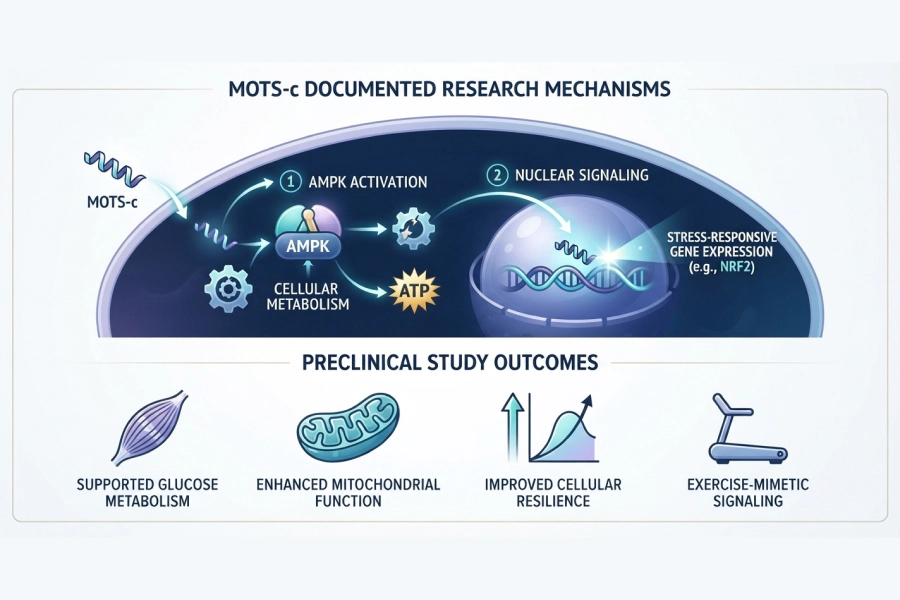
Key Findings in MOTS-C Peptide Research
Ongoing MOTS-C peptide research continues to examine how these signaling pathways influence metabolic resilience and cellular energy balance.
MOTS-C peptide research has gained significant attention in cellular metabolism and bioenergetics studies because MOTS-C is a 16-amino-acid mitochondrial-derived peptide.
high-purity MOTS-C (Mitochondrial Open Reading Frame of the 12S rRNA-c) is a 16-amino-acid mitochondrial-derived peptide (MDP) encoded within the mitochondrial genome rather than nuclear DNA. Since its discovery, MOTS-C has become a major focal point in bioenergetic, metabolic, and cellular longevity research due to its unique role as a retrograde signaling molecule—communicating directly from the mitochondria to the cell nucleus in response to metabolic stress.
Below is an overview of the primary mechanisms and documented research benefits observed in preclinical and in-vitro studies involving MOTS-C.
1. Activation of the AMPK Metabolic Pathway
One of the most extensively studied mechanisms of MOTS-C is its interaction with the folate-methionine cycle and subsequent activation of AMP-activated protein kinase (AMPK)—often referred to as the master regulator of cellular energy homeostasis.
- De Novo Purine Biosynthesis Regulation: Research indicates that MOTS-C inhibits the folate cycle at the level of 5-methyltetrahydrofolate (5-MTHF), leading to an accumulation of endogenous AICAR (5-aminoimidazole-4-carboxamide ribonucleotide), a well-characterized AMPK activator.
- Cellular Energy Balance: Through AMPK phosphorylation, MOTS-C promotes catabolic pathways that generate ATP (such as glucose uptake and fatty acid oxidation) while downregulating energy-consuming anabolic processes.
2. Support for Glucose Metabolism and Insulin Sensitivity
In preclinical metabolic models, MOTS-C has demonstrated significant effects on systemic glucose regulation and skeletal muscle metabolism.
- GLUT4 Translocation: Studies in skeletal muscle tissue show that MOTS-C enhances glucose clearance by promoting the translocation of glucose transporter type 4 (GLUT4) to the plasma membrane, independent of the canonical insulin signaling cascade.
- Protection Against Diet-Induced Metabolic Stress: Animal models subjected to high-fat diets have shown that MOTS-C administration helps preserve insulin sensitivity and prevents metabolic dysfunction, making it a key reference compound in metabolic syndrome research.
3. Nuclear Translocation and Stress Adaptation
Unlike traditional peptides that act strictly on cell-surface receptors, MOTS-C exhibits the ability to translocate directly into the cell nucleus under conditions of oxidative or metabolic stress (such as glucose restriction or reactive oxygen species elevation).
- Gene Expression Modulation: Once inside the nucleus, MOTS-C interacts with stress-responsive transcription factors—including NRF2 (Nuclear Factor Erythroid 2-Related Factor 2)—to regulate the expression of antioxidant and cytoprotective genes.
- Enhanced Cellular Resilience: This nuclear signaling mechanism helps cells adapt to metabolic scarcity and oxidative damage, improving cell survival under challenging in-vitro assay conditions.
4. Mitochondrial Biogenesis and Physical Capacity Models
Because MOTS-C originates within the mitochondria, researchers frequently investigate its role in maintaining mitochondrial function and cellular endurance.
- Mitochondrial Health: Preclinical data suggest that MOTS-C helps maintain mitochondrial membrane potential and supports mitochondrial biogenesis in aging or metabolically stressed tissue models.
- Exercise-Mimetic Signaling: In rodent studies, MOTS-C signaling patterns closely mirror physiological adaptations observed during aerobic exercise, including improved metabolic flexibility and skeletal muscle performance metrics.
Sourcing High-Purity MOTS-C for Laboratory Research
Reproducible data in metabolic and cellular signaling assays require reference materials with verified sequence identity and minimal synthesis impurities. Every batch of MOTS-C available through the Ancestral Bio Catalog undergoes third-party analytical testing—including HPLC purity and mass spectrometry verification—with batch documentation accessible in our COA Directory.
Compliance Notice: All compounds supplied by Ancestral Bio, including MOTS-C, are strictly intended for in-vitro laboratory research and analytical testing only. They are not for human or veterinary consumption, diagnostic use, or therapeutic application.
AMPK Pathway, In-Vitro Research, Metabolic Research, Mitochondrial Peptides, MOTS-c, Peptide Science